
Repair the original
Where the fault is repairable, retaining the original unit can preserve the vehicle data and avoid an unnecessary replacement.
Original ECU · tested donor · vehicle data
A compatible replacement may need supported data transferred from the original unit, or it may need programming and coding to the vehicle. We identify the hardware and prove the route before work begins.
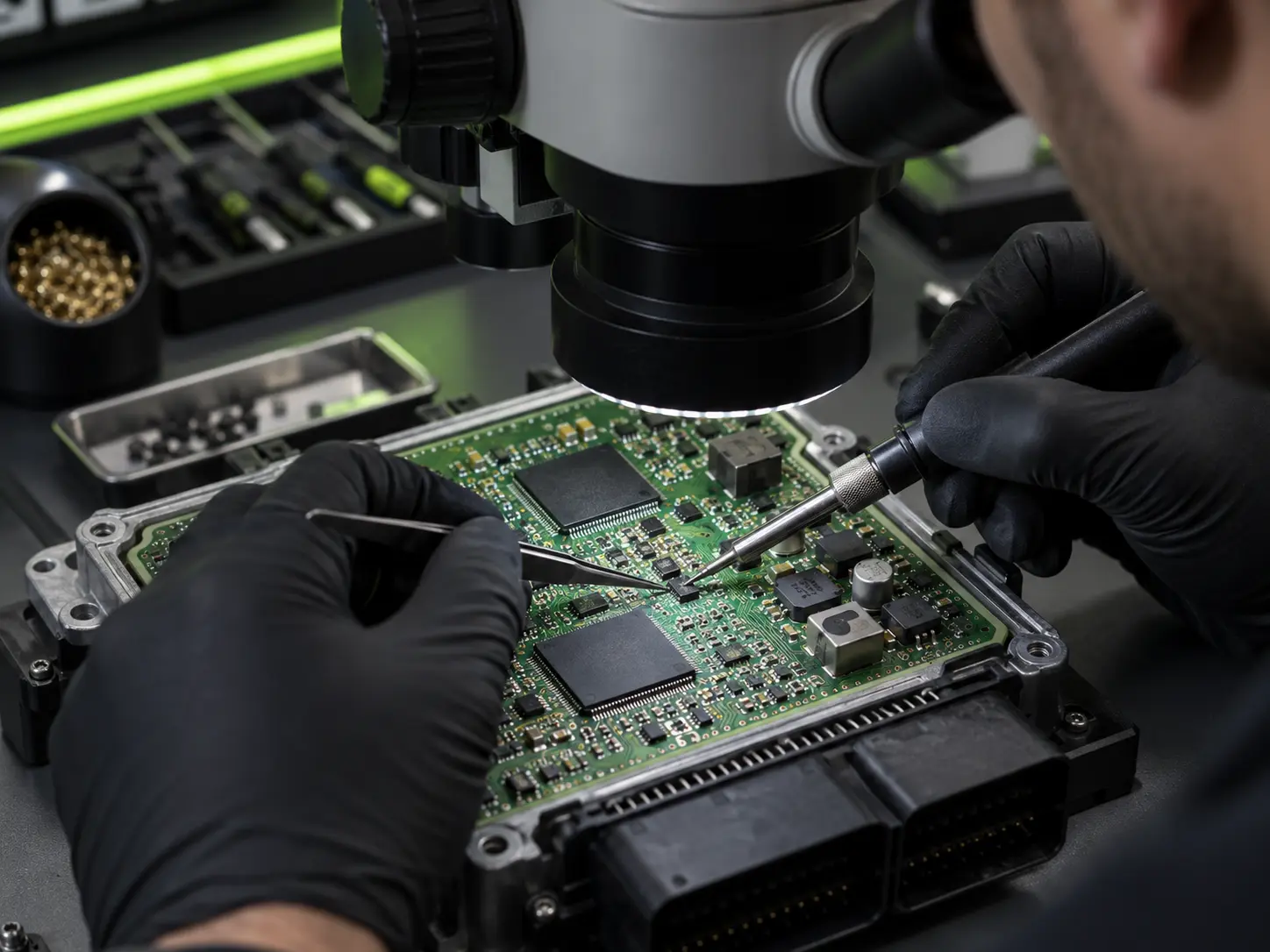
Three technical routes
A new ECU can cost more than £2,000 on some makes and models. Repairing the original or using a tested donor can cost a fraction when it is technically appropriate—but the cheapest-looking box is not always the correct route.
Where the fault is repairable, retaining the original unit can preserve the vehicle data and avoid an unnecessary replacement.
Where supported data can be read and the donor is compatible, the required information may be transferred to the tested replacement.
Some new, donor or superseded units need to be treated as a replacement ECU and programmed, coded or adapted to the vehicle.
The labels matter
In most straightforward cloning jobs, the original and donor ECUs should be identical. Occasionally a unit has been superseded and a verified alternative can be programmed to the vehicle. That decision needs hardware, software and vehicle evidence—not a similar-looking case.
Can the original communicate? Can the required data be read safely? Is repair the better option?
Does it genuinely match, is it healthy, and will the supported cloning or programming route work?
Proper diagnostics. Done correctly.
Confirm the vehicle, original ECU and proposed donor before quoting or accepting the units.
Check the units, connectors and available data. A faulty customer-supplied donor cannot become a reliable replacement.
Complete the supported cloning, programming, coding or adaptation route agreed for that ECU and vehicle.
Bench checks and, where required, vehicle-side commissioning confirm the result without promising what has not been tested.
Start with what you have
For the first conversation, make, model and year plus the registration, VIN or a clear ECU-label photograph is enough. If two units are being supplied for cloning, send a readable image of both labels.
Original ECU label
Donor ECU label
Both sides of each case
Connector pins photographed straight on
Do not hold back an enquiry because every photograph is not available. We can begin with the vehicle details or one readable label and explain what is needed next.Clear before work begins
No fixed price from a registration alone. Cost depends on the exact ECU, condition, donor, access method and programming required.
Accepted subject to testing. If the supplied unit is faulty or unsuitable, inspection and testing fees may still apply.
The majority of straightforward cloning work is completed the same day. Diagnosis is aimed within 48 hours; repair work normally takes 5–10 business days depending on parts and complexity.
Engine Clean warrants its own work. Customer-supplied parts, misuse, fresh water damage and faults outside the agreed repair are not covered.
Straight answers
No. The route depends on the exact ECU, the failure, whether the original data can be read and whether the proposed donor is compatible. Some units can be cloned; others need repair, programming, coding or a different replacement route.
For most straightforward cloning work, the original and donor should be an identical match. This is not an absolute rule: some manufacturers supersede units and a verified replacement can sometimes be programmed to the vehicle instead. Photographs of both labels allow us to check before anything is sent.
No. Cloning transfers supported data from one compatible unit to another. Coding and programming configure a replacement unit for the vehicle. The correct process depends on the ECU and vehicle.
The price cannot be confirmed from the vehicle alone. We need the make, model and year plus the registration, VIN or ECU label, and details of the original and donor units where applicable.
Yes, subject to identification and testing. If a customer- or trade-supplied donor is faulty, unsuitable or cannot complete the required work, inspection and testing fees may still apply.
Suitable removed-unit enquiries are welcomed from across the UK, but contact us before posting. We first confirm the hardware, proposed work, booking reference and delivery instructions.
Need the broader service?
Original ECU, donor ECU or both?